
Quanta Meridian logo
Skip insight types

Insights

Plain answers to difficult reporting and analysis questions.

The current pieces explain why Finance and Power BI can disagree, why a corrected data problem still needs an independent check, how a forecast compares with a useful baseline, and when a challenger is strong enough to test further. Each answer begins with the practical question, then shows the retained figures, method and limitation.

question · analysis · answer

Editorial key

Choose the level of detail you need.

Articles explain a business question, Technical Notes focus on an implementation choice, and Research Briefs test a question against saved results. Only published pieces are listed here.
01

Article

Explains a reporting disagreement in practical language.

Articles answer a reporting or analytical question in ordinary language, using a detailed project example to show why the answer matters.
1 Article
02

Technical Note

Explains an implementation choice with the relevant code, workbook or model detail.

Technical Notes focus on one implementation decision and show the relevant code, workbook or model detail.
0 Technical Notes
03

Research Brief

Tests one question against sources and saved results.

Research Briefs set out the question, sources, method, finding and limitations without claiming more than the analysis supports.
3 Research Briefs

Article

Understand the disagreement

Articles answer a reporting or analytical question in ordinary language, using a detailed project example to show why the answer matters.1 Article
  1. Question

    Why on-time delivery reports disagree

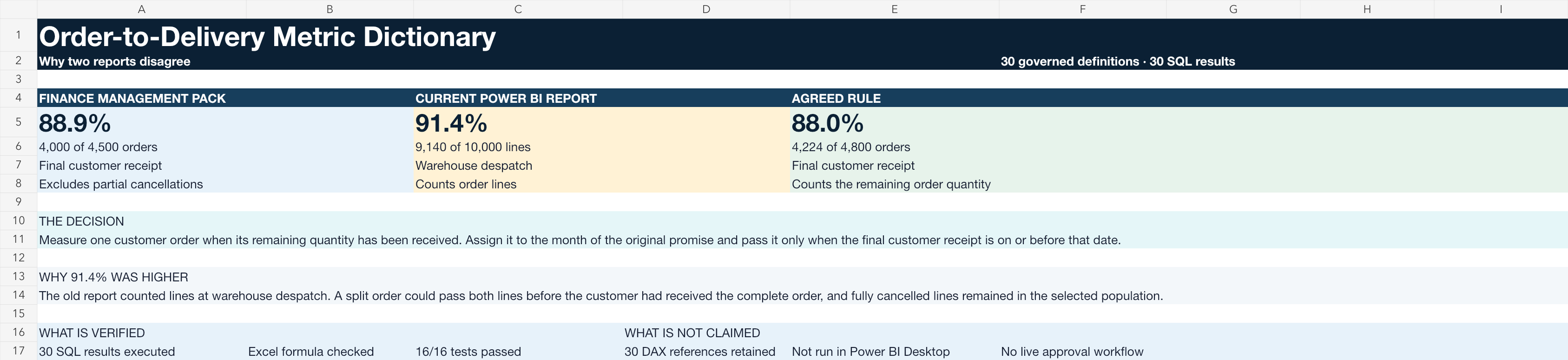
    Why can Finance and Power BI calculate different on-time delivery rates from the same orders?

  2. Source

    ORD-0004001 · two order lines · original promise 10 June 2025

  3. Evidence

    Order and final receipt · order line and warehouse despatch

  4. Agreed rule

    One eligible order · final customer receipt · accepted partial cancellation reduces the quantity still owed

  5. Reporting consequence

    Apply the same 88.0% rule in SQL and Excel; retain DAX as not yet run in Power BI Desktop.

Research Brief

Separate the finding from the claim

Research Briefs set out the question, sources, method, finding and limitations without claiming more than the analysis supports.3 Research Briefs
  1. Question

    Why a data fix does not release the report

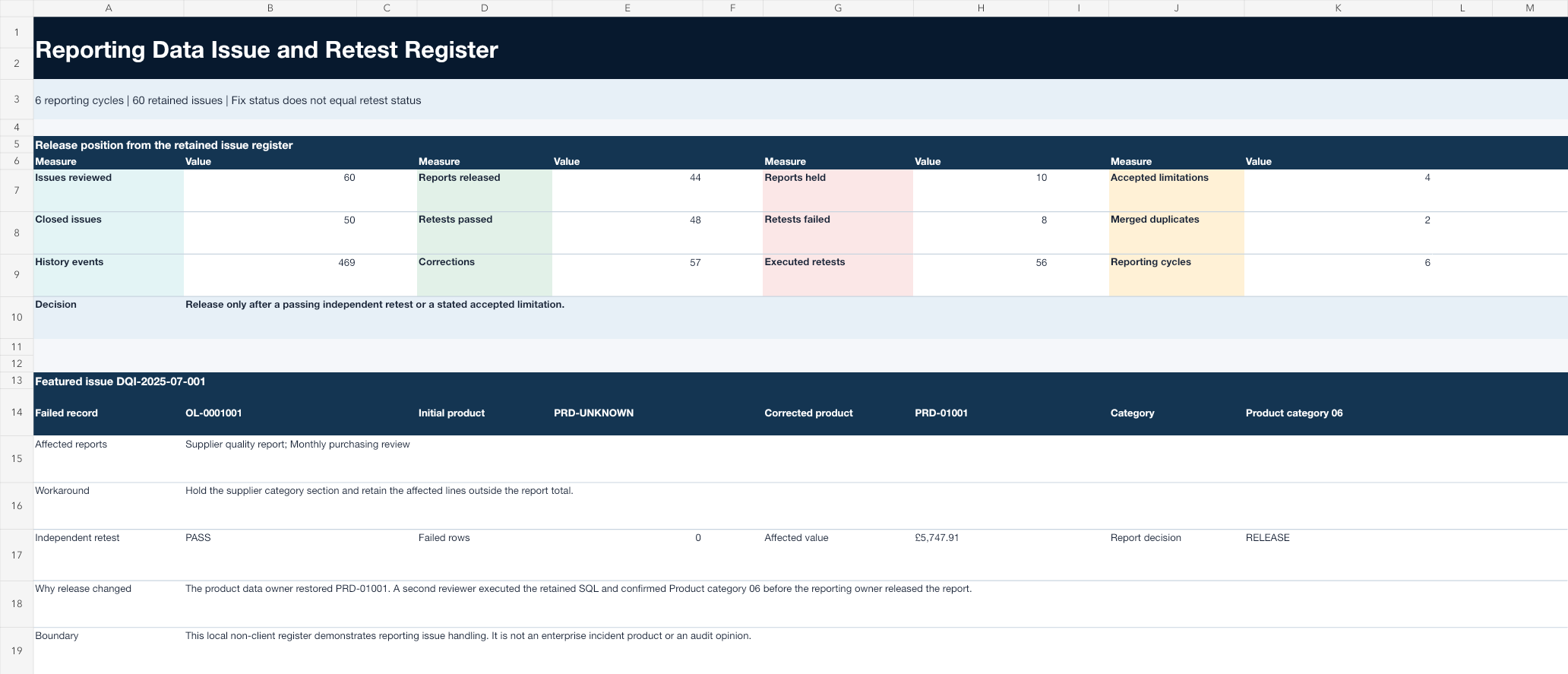
    Why is correcting a missing product code different from proving the monthly report is safe to release?

  2. Source

    DQI-2025-07-001 · OL-0001001 · supplier report held

  3. Evidence

    PRD-UNKNOWN → PRD-01001 · independent SQL retest: PASS

  4. Qualification

    This is one deliberately generated non-client issue. The passing query proves the specified product mapping and affected value; it does not prove that every field or supplier total in the report is correct.

  5. Practical implication

    A reporting issue process should keep the attempted fix, retest result, tester, affected report and publish or hold outcome as separate records. Marking the fix complete should never remove the report hold by itself.

  1. Question

    Can a cycle-hire forecast beat simply repeating last week?

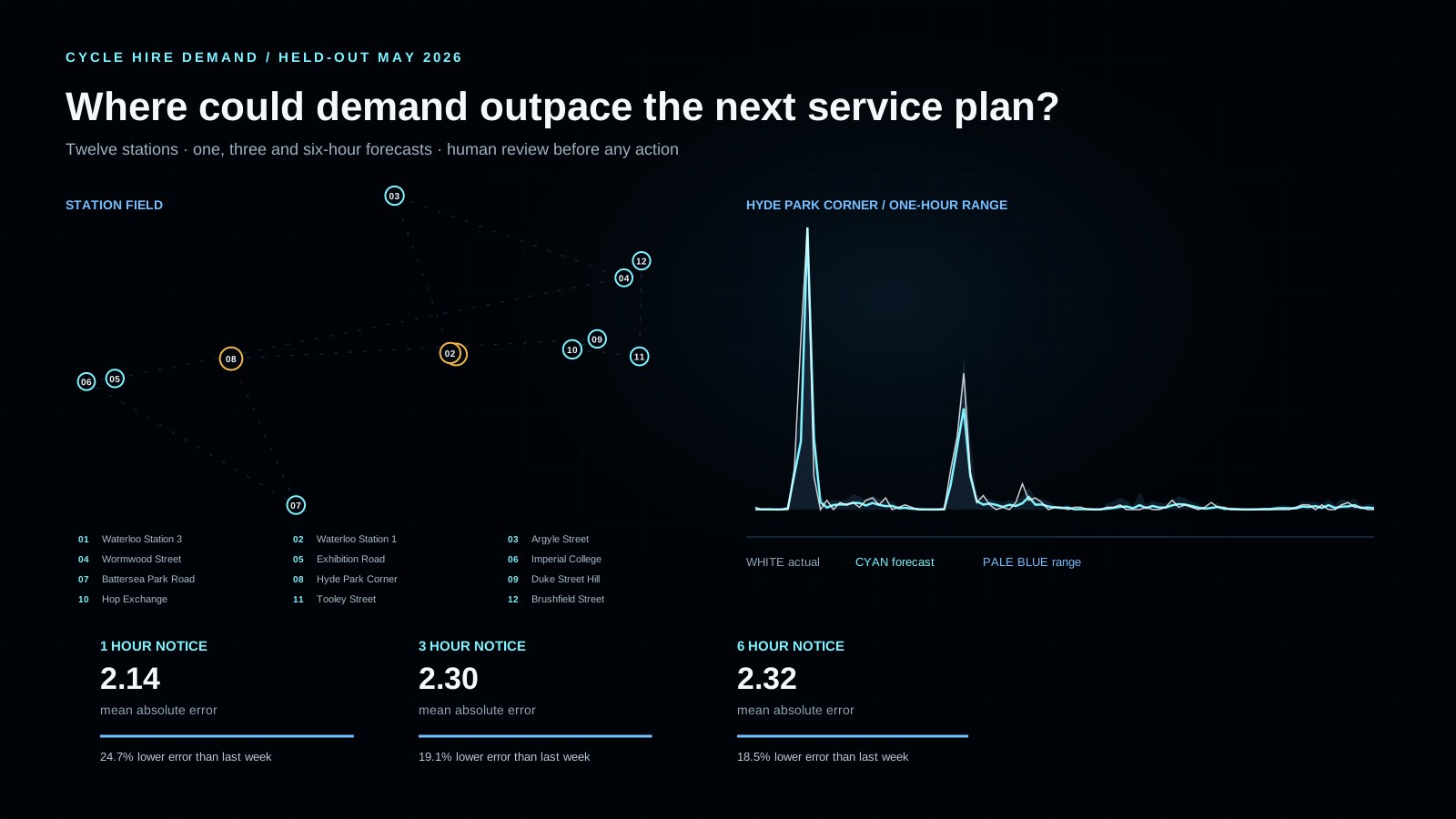
    How can a service planner tell whether a demand forecast is genuinely more useful than repeating last week?

  2. Source

    3,563,266 TfL journey records · twelve-station subset · January–May 2026

  3. Evidence

    26,784 later forecasts · 20.8% lower MAE than the weekly baseline

  4. Qualification

    Completed departures measure observed hires, not unmet demand or live cycle availability. The twelve-station subset, five-month period and absent weather, closure and rebalancing records limit operational interpretation. The result is not causal and the model is not deployed.

  5. Practical implication

    A planning forecast should retain issue time, target time, baseline result, forecast range and later error for every prediction. High error or a wide range should lead to a named operational check, not an automatic instruction.

The selected cycle-hire model reduced mean absolute error by 20.8% against the same-station, same-hour weekly baseline on 26,784 later forecasts, while retaining forecast ranges and errors for planner review.

Published 1 Aug 2026 · reviewed 1 Aug 2026 · 4 sources

Based on the project Cycle Hire Demand and Service Planning

Read the Research Brief
  1. Question

    When is a better forecast strong enough to test further?

    The R correction has a lower average error. Why was the published forecast still retained?

  2. Source

    Six fixed 28-day origins · 8,066 held-out half-hours

  3. Evidence

    Published 697.9 MW · R 683.0 MW · Python 693.0 MW

  4. Selection gate

    R passes all five checks; Python misses the MAE-improvement and interval-coverage checks.

  5. Operating reference

    R moves only to further controlled review. The published forecast remains the operating reference.