Suggest the record type
A TF-IDF and logistic-regression baseline reads retained text and scores six generated classes.
- Class suggestion
- Ranked scores
- Model and dataset version

Contained Python build
A Finance and Operations intake receives mixed invoices, credit notes, receipts, evidence documents and reporting requests. The build prepares a suggested record and queue, but holds contradictory or incomplete items for a named reviewer.
Should the intake analyst accept the suggested class and fields, edit them, reject the record or send it to a different specialist queue?
Prepared record
Credit note suggestedPositive credit amount and mixed invoice wording need a person to decide the posting treatment.
The intake situation
A multi-site service company uses one shared intake for supplier documents, expense receipts, control evidence and reporting requests. Sending a credit note to the invoice queue or treating an incomplete request as ready creates rework and can hide the reason for a later correction.
The build prepares a record for the intake analyst. It does not approve a payment, accept control evidence or decide what analysis a reporting request needs.
One record in full
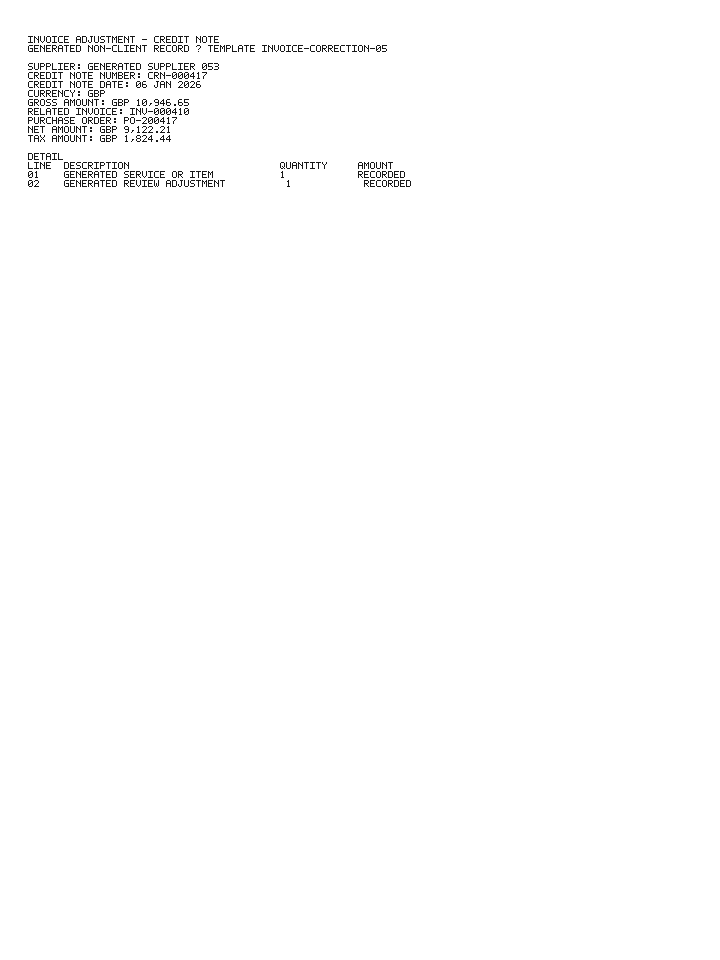
A score of 99.1% is retained as a model output, not presented as a calibrated probability. 2 deterministic checks still require a person.
9 retained fields connect supplier, credit-note, date, amount, invoice and purchase-order values to page one.
The text classifier selects the credit-note class with a retained score of 99.1%. The score does not release the record.
The positive displayed amount and “invoice adjustment” heading fail 2 release-blocking checks.
The accounts payable analyst retains the displayed value and records -£10,946.65 as the posting adjustment.
9 events retain the document, suggestion, rules, correction and final accounts-payable adjustments queue.
How the decision is prepared
A TF-IDF and logistic-regression baseline reads retained text and scores six generated classes.
Named patterns extract fields, while rules test required values, dates, amounts and contradictory wording.
The person sees the page, suggestion, extracted fields and failed checks before recording a reasoned decision.
Evaluation before a pilot
Template families are separated before training and test. The page shows the clean classification result beside extraction errors, abstention and two known policy failures.
This clean diagonal is a result for deterministic generated templates, not an accuracy claim for real invoices, scans or handwriting.
The two known failures are invalid-date reporting requests. They remain in the error register and block any operational pilot.
of generated test documents had every expected field exactly matched.
The validation partitions had no class error, so wrong-prediction calibration remains unobserved.
Real documents, privacy, security, access, retention and monitoring have not been tested.
Native reviewer evidence
This screenshot comes from the contained local service. It keeps the generated page, model suggestion, extracted fields, failed checks and human correction in one review path.
Correction and audit
What this build does not prove
The fixed-seed generator rebuilds 6,000 documents across 68 template families. The locked Python package includes a command-line interface, local service, reviewer screen and container definition.
Corpus integrity, template separation, class and field evaluation, threshold analysis, audit-chain verification and responsive reviewer-screen checks.
The model card states the training data, intended use, measured results, score boundary and reasons an operational pilot is not approved.