CompletenessDQ-10
Is every expected monthly order file present?
A missing month changes the report population and its denominators.
Initial FAIL · independent retest PASS
Data Quality
For reporting, data and operational teams that need to decide whether a scheduled report can be issued, limited or held.
Quanta Meridian shows which order or delivery row failed, which service or supplier result would be wrong, who must correct the customer or product record and what the independent retest found.
When data needs a controlled response
Order ORD-0001041 records customer receipt on 16 November and warehouse despatch on 17 November. That impossible sequence would produce a negative delivery cycle time if it entered the monthly service report.
A failure count alone cannot tell the reporting analyst what to do. The retained row must show the two events, DQ-04, the affected delivery measures and the warehouse systems analyst responsible for correcting the warehouse timeline.
The order remains outside on-time and cycle-time reporting until an independent reviewer runs DQ-04 again. The original events, amended dates, retest and decision to include or exclude the order stay connected.
Rules test the batch in order. Material failures retain their record keys, affected report and owner, then return through the same rule for retest.
A missing month changes the report population and its denominators.
Initial FAIL · independent retest PASSA future-dated order cannot enter the December reporting period.
Initial FAIL · independent retest PASSA residual difference holds sales value and margin from release.
Initial FAIL · independent retest PASSColumns · types · keys
Required · unique · timely
Sequence · references · totals
Release only after all 19 checks pass
Record key · rule · value · expected condition
Customer, product and on-time delivery results
Evidence and target retest remain in history
Columns · types · keys
Required · unique · timely
Sequence · references · totals
Assign an owner only when the threshold or impact warrants it.
Order ORD-0001041 is excluded from delivery measures when its customer receipt appears before warehouse despatch. The original events remain beside the corrected timeline.
Customer receipt · 2024-11-16
Warehouse despatch · 2024-11-17
Customer receipt is dated one day before warehouse despatch.
Hold on-time delivery and order cycle-time reportingCorrect the two retained event dates and preserve the amended timeline.
Warehouse systems analystWarehouse despatch · 2024-11-16
Customer receipt · 2024-11-17
Publish or hold: The order is admitted to delivery cycle-time and on-time reporting.
View the rule and failed rowsResult states
Status is written as text and paired with its consequence. Colour is used only to help scanning.
The observed result met the agreed threshold.
Retain the run result and continue.The result needs review but does not automatically block the report.
Assess impact and record any limitation.The observed result breached the threshold for this reporting purpose.
Hold or limit the affected report and assign the failed rows as agreed.The check did not complete, so it cannot support a quality conclusion.
Resolve the execution problem and run it again.Data-quality review history
The same configured check is used for the first run and retest so the correction can be compared with the observed failure.
Each check names the order or delivery fields tested, the threshold and the report consequence. The run keeps its input period, identifier, time, observed result and failed record keys.
A missing customer code is assigned to the customer-data owner; a missing product mapping goes to the product-data owner. The reporting owner records whether the affected page is held or issued with a stated limitation.
After the customer, product or delivery record is corrected, the same rule is run again by a second analyst. Only a passing retest and reconciled row total allow the held row or report page to return.
Check result and incident
It records the rule, threshold and severity alongside the input, run time and result state. Failed record keys retain the observed values and show which measure or report is affected.
It adds impact, urgency and recurrence, then keeps the data owner’s response, correction or accepted limitation. Retest evidence supports the final closure decision and history.
A bounded first review
The first engagement does not require a platform programme. It establishes whether one material result is blocked by missing records, invalid values or a reconciliation difference, then names the control and owner needed next.
The check and retest package
Agree what should be tested and what each result means for the reporting purpose.
The retained package contains rule, severity and threshold register and dataset, field and affected-report mapping.
Retain the run and the records needed to explain where the data failed.
The retained package contains configuration-driven SQL or Python checks and run metadata, failed records and quarantine table.
Connect material failures to an owner, a reporting decision and evidence from the retest.
The retained package contains issue or accepted-limitation record and named owner, retest history and publish or hold outcome.
A finished example
Validation, incident history, model controls and metric reconciliation need different evidence. Each featured build keeps its input, execution, tie-out and limitation visible.
Executed rule results
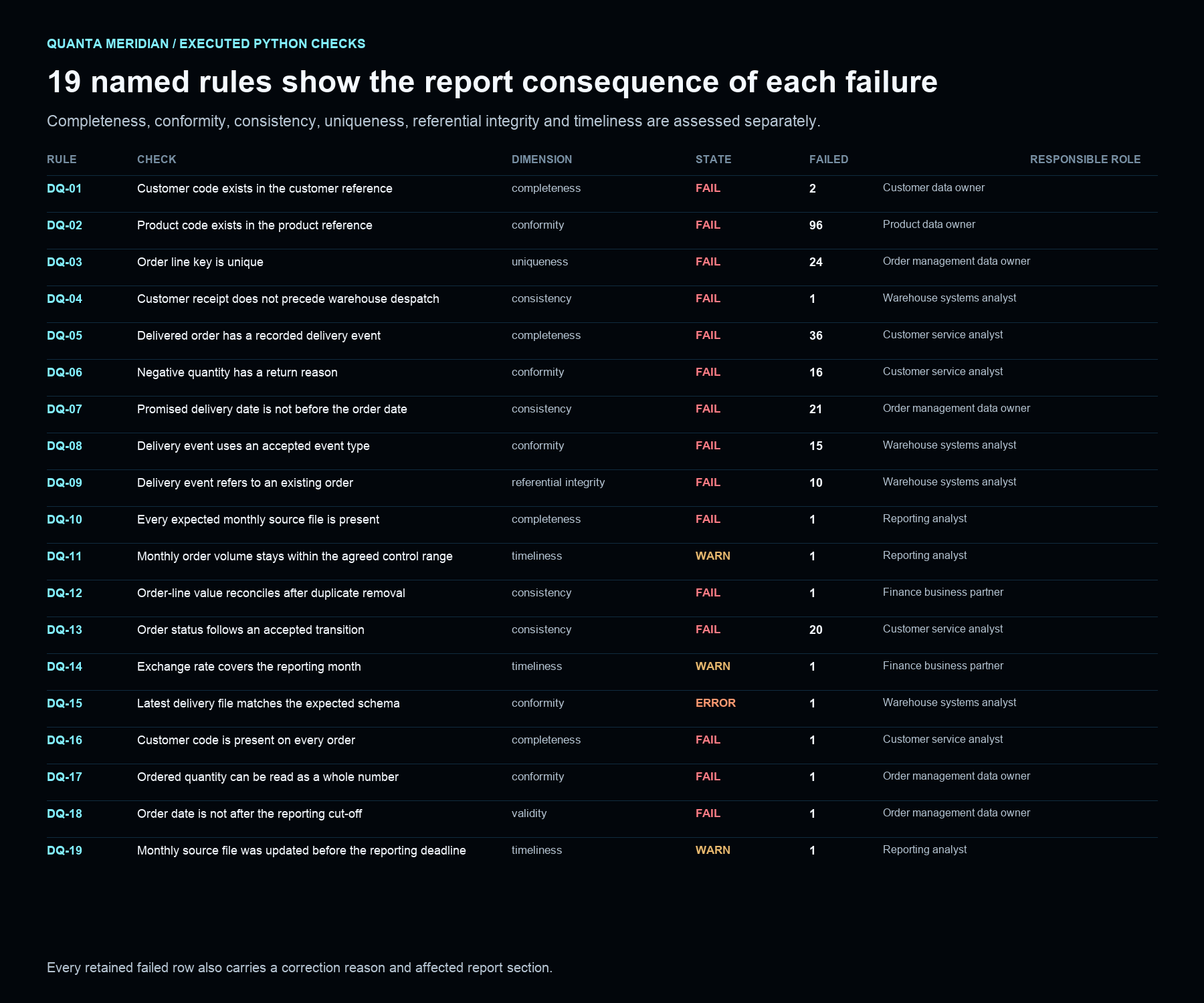
A repeatable set of checks that stops incomplete or contradictory order records from entering the monthly service report and gives each failed row a specific correction reason.
Inspect Order and Delivery Data Quality ChecksOne reporting incident from detection to release
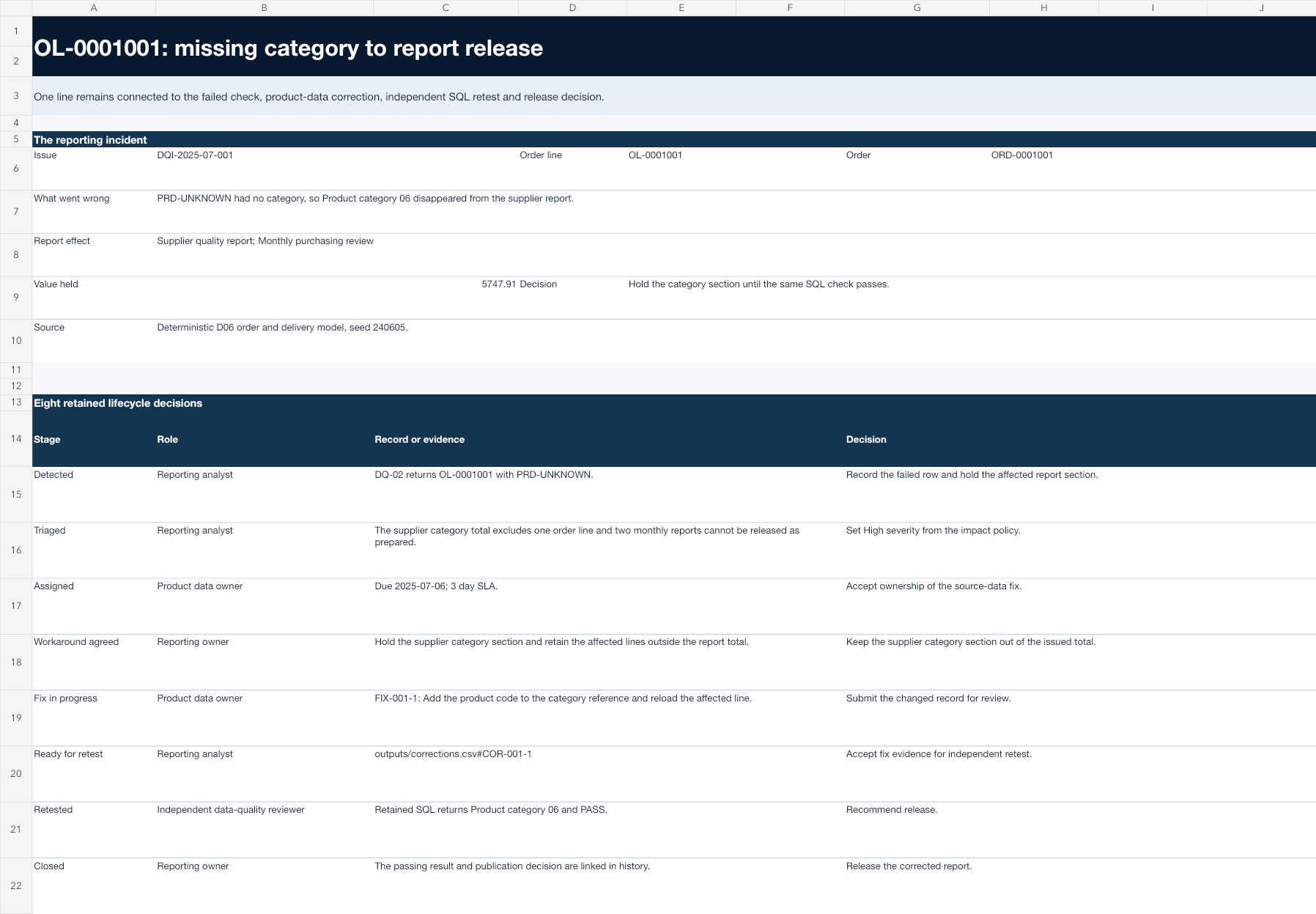
A reporting data incident register that holds an affected report section, separates the product-record correction from independent retest and records release, limitation or reopening without erasing history.
Inspect Reporting Data Issue and Retest RegisterDuckDB mart results and report checks
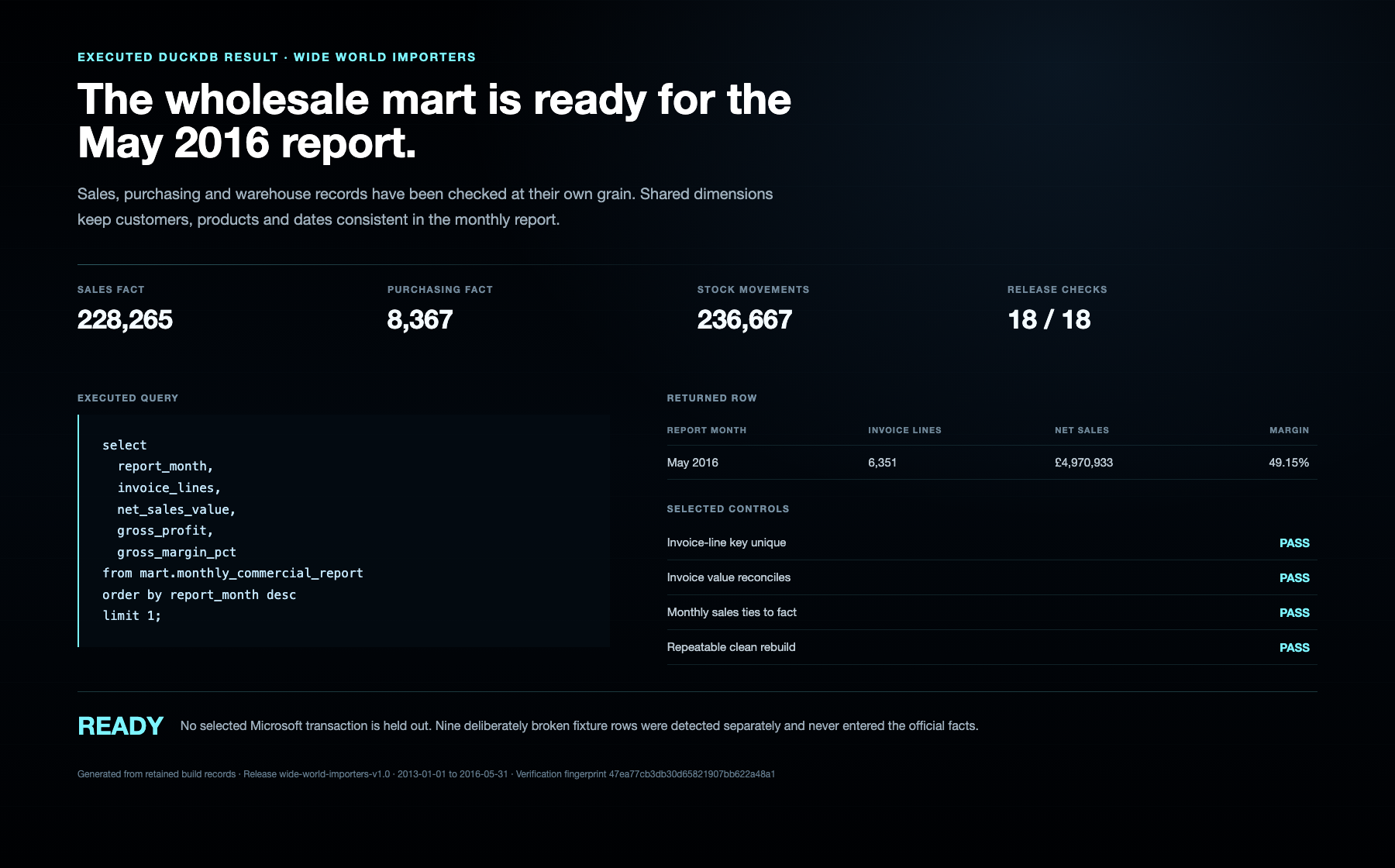
A reporting analyst prepares the wholesaler’s May sales, margin and stock report from invoice lines, supplier orders and warehouse movements, with each figure checked before finance, sales and warehouse managers use it.
Inspect Wholesale Sales, Margin and Stock Reporting MartExact percentage bridge
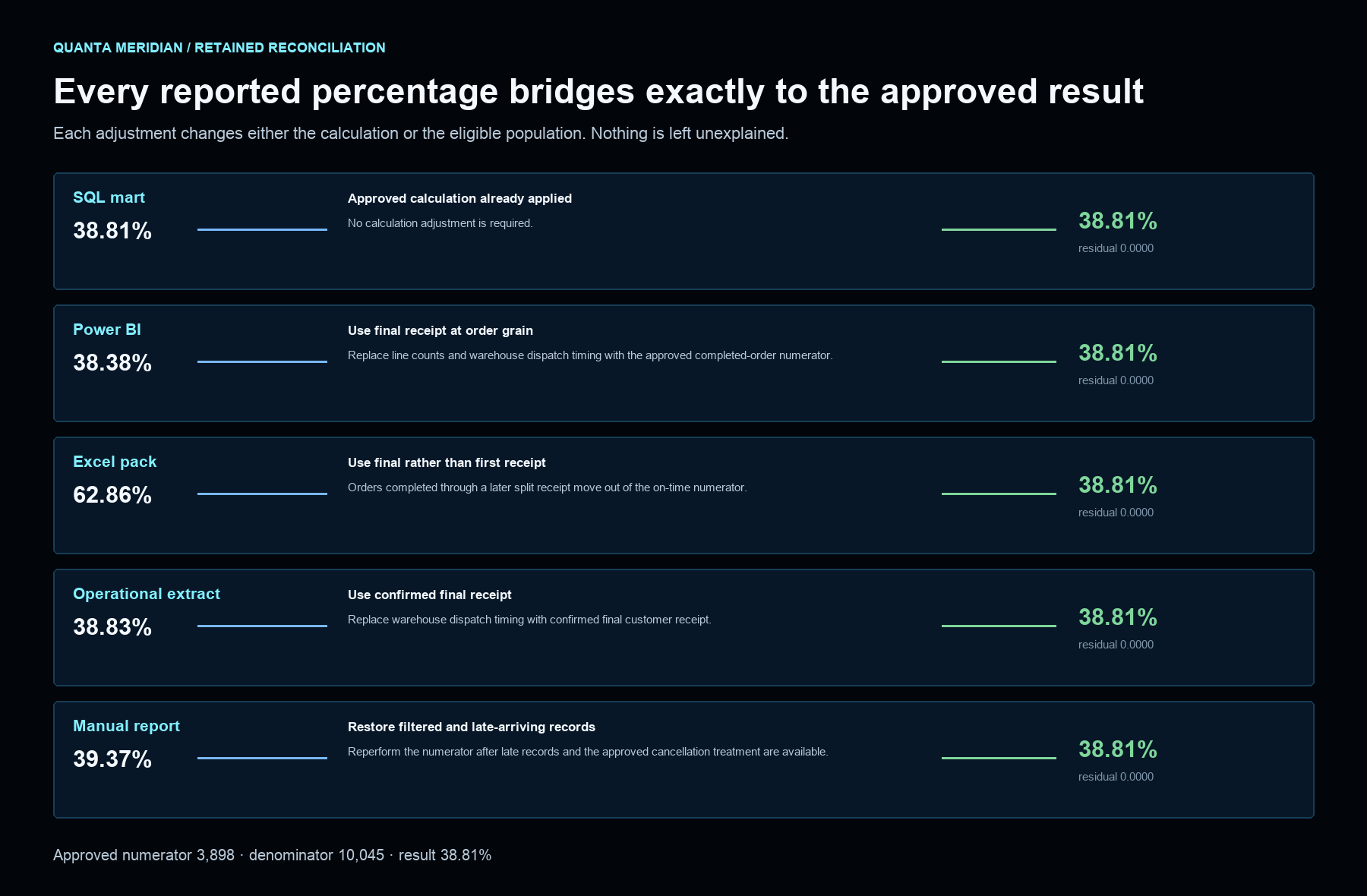
A row-level reconciliation explaining why the SQL reporting mart, Power BI model, Excel management pack, operational extract and manually maintained report show different on-time delivery percentages.
Inspect Why five reports show different on-time delivery ratesTechnical patterns
Columns, types, keys or file structures must remain stable enough for the next process to run.
A valid structure does not show that the values are complete, timely or meaningful for the report.
Records need tests for completeness, uniqueness, validity, freshness, sequence or reference integrity.
Thresholds must reflect the reporting purpose; a universal quality score cannot make that decision.
Amounts, populations or states must reconcile to an agreed definition before a report can be issued.
The rule needs a business owner and must not silently replace a disputed definition.
A recurring or material failure needs ownership, impact assessment, a recorded data correction and independent retest.
Minor warnings can remain check results. Creating an incident for every failed row adds noise without improving the data.
Related capabilities
Python turns reporting rules and analytical methods into repeatable runs with declared inputs, retained results and tests another analyst can inspect.
Explore the Python capabilitySQL gives invoice lines, orders, receipts and reference data a declared grain before they become shared reporting totals.
Explore the SQL capabilityExcel and Power Query are used when people need a familiar workbook without hiding file intake, transformation logic, adjustments or checks.
Explore the Excel and Power Query capabilityStart the review
The first conversation can work from field names, rule wording and the reporting consequence. Confidential customer or employee records are not needed to decide whether a focused review is useful.
Bring one report, the records that cause concern and the decision due next. Confidential or protected data is not needed for the first conversation.
Discuss a data quality reviewReturn to all solutions